← Back to scan
Push this scan report to
File as GitHub Issue
repo:
multica-ai/multica
Push this scan report to multica-ai/multica
Click the green button below to open GitHub’s new-issue form, pre-filled with the report title, summary table, top findings, and an embedded score-card image. No authentication needed — you review on GitHub before submitting. Repobility is credited as the scanner.
Embedded score card image
This image will render at the top of the issue body. Hosted on Repobility, refreshes automatically after re-scans.
Issue title
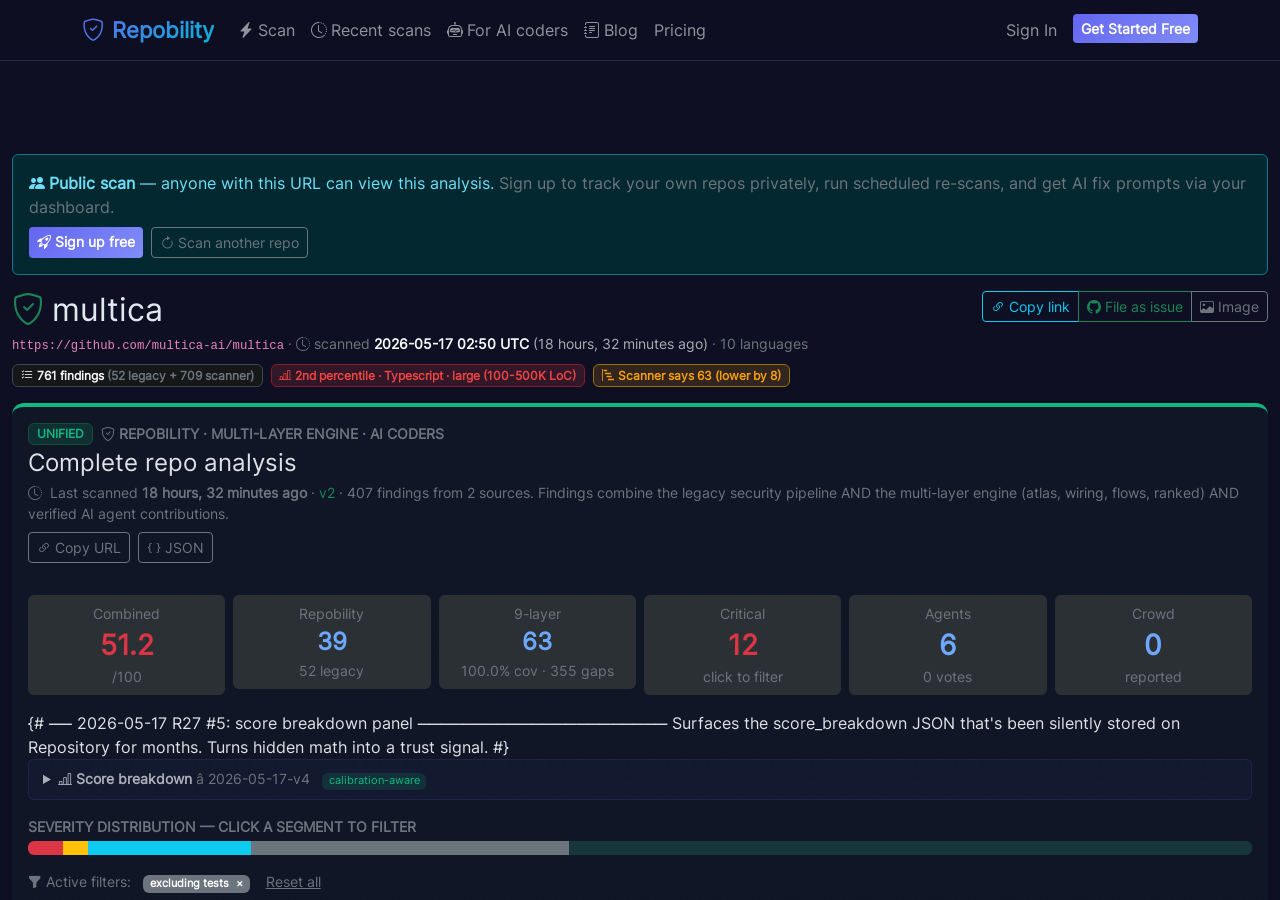
Code quality scan: 52 findings (C, 52/100)
Issue body (markdown)
Hi @multica-ai, an automated scan of this repository surfaced **52 code-quality findings** that may be worth a look. Full details, severity filters, and per-file context are at the link below — feel free to close this issue if it isn't useful to you. ## Full interactive report **https://repobility.com/scan/a3a23df1-c446-4e56-a160-ed8bb6252f50/**  ## At a glance - **Score**: `52/100` • **Grade**: `C` - **Scanned**: `2026-05-17 02:50 UTC` - **Lines of code**: 254,135 - **Total findings**: 52 - **Security-tagged**: 19 - **Credential / secret patterns**: 5 ## Top issues, with file & line _These are deterministic rule-based findings — the file paths and line numbers below are real and can be verified in your tree._ 1. **[critical]** [SEC022] Database URL With Embedded Credential: A database connection URL contains an embedded username and password. These URLs are often copied into defaults, docs, and scripts, then leak working credentials. — `scripts/init-worktree-env.sh:31` _Remove the embedded password, require the URL from a secret store or environment variable, and rotate the database credential._ 2. **[critical]** [SEC022] Database URL With Embedded Credential: A database connection URL contains an embedded username and password. These URLs are often copied into defaults, docs, and scripts, then leak working credentials. — `scripts/screenshot-pr-cards.mjs:14` _Remove the embedded password, require the URL from a secret store or environment variable, and rotate the database credential._ 3. **[critical]** [SEC022] Database URL With Embedded Credential: A database connection URL contains an embedded username and password. These URLs are often copied into defaults, docs, and scripts, then leak working credentials. — `server/cmd/backfill_task_usage_daily/main.go:49` _Remove the embedded password, require the URL from a secret store or environment variable, and rotate the database credential._ 4. **[critical]** Compose service contains a literal secret environment value — `docker-compose.yml:3` _Literal secrets in Compose files are committed to source and exposed through container inspection._ 5. **[critical]** [SEC001] Hardcoded Password: Hardcoded password found in source code. — `scripts/ensure-postgres.sh:19` _Use environment variables or a secrets manager._ See all 52 findings, with severity filters and AI fix prompts: **https://repobility.com/scan/a3a23df1-c446-4e56-a160-ed8bb6252f50/** --- **What is this?** [Repobility](https://repobility.com) is a research project that scans public repositories with a multi-layer static analyzer (rule-based, no AI hallucinations) and learns code-quality patterns across a broad cross-repo corpus. This is **not a sales pitch** — there's no paywall, no signup required to view the report, and no payment ask. If the findings aren't useful, please close this issue and we won't post again. **To re-run after fixes land:** paste your repo URL at [repobility.com](https://repobility.com) — fresh scan, free. _Issue filed via the public Repobility report at https://repobility.com/scan/a3a23df1-c446-4e56-a160-ed8bb6252f50/._
The button opens GitHub’s new-issue page in a new tab. You will see the title + body pre-filled — review, edit if you want, then click GitHub’s "Submit new issue" button. Repobility never posts anything on your behalf.